
W e l c o m e t o N u t r i - C h e c k N E T
Disable Preloader
  • heurope.nutrichecknet@gmail.com
Ecoife Logo Light Ecoife Logo Dark
  • The project
    • About NUTRI-CHECK NET
    • Project Partners
    • Related Projects
  • News
  • Events
    • Events
    • Final Conference
  • NUTRI-CHECK NET Platform
  • Results
    • Crop Nutrition Club
    • Deliverables
    • Practice Abstracts
    • Factsheets
    • Policy Briefs
  • Communication & Dissemination
    • Flyer
    • Newsletters
    • Press Releases
  • Contact Us
Contact Us
  • The project
    • About NUTRI-CHECK NET
    • Project Partners
    • Related Projects
  • News
  • Events
    • Events
    • Final Conference
  • NUTRI-CHECK NET Platform
  • Results
    • Crop Nutrition Club
    • Deliverables
    • Practice Abstracts
    • Factsheets
    • Policy Briefs
  • Communication & Dissemination
    • Flyer
    • Newsletters
    • Press Releases
  • Contact Us

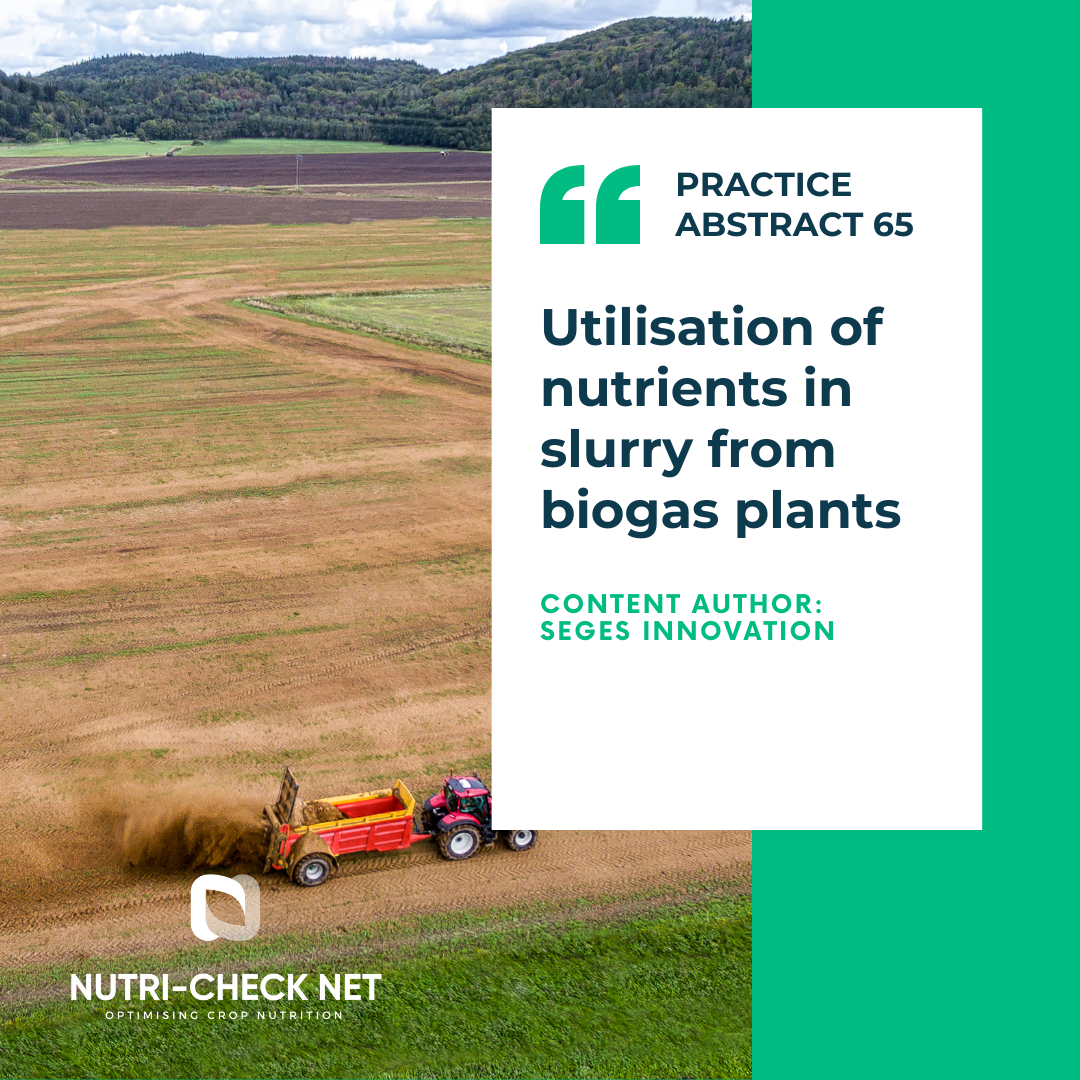
Utilisation of nutrients in slurry from biogas plants

Content Author: SEGES Innovation

When slurry is processed in a biogas plant, organic nitrogen (N) is partially mineralised to ammonium (NH4+), which increases the nutrient value. NH4+-N in digested slurry can vary between 60-80 % depending on the digested biomass type. In Denmark, the fertiliser value for N in slurry is set by law to 75-80 %. The fertiliser value of digested biomass might be higher, especially if efforts are made to reduce ammonia (NH3) loss. However, biomasses with a high content of dry matter (DM), e.g. deep litter, straw and energy crops, lowers the nutrient value of the digestates as it reduces the share of ammonium N, and the higher DM con-tent prolongs the time before the slurry infiltrates the soil. This increases the risk of NH3 volatilisation – par-ticularly in combination with the rise in pH which is a side effect of the biogas process. At high DM contents, it is important to use slurry application technologies that reduce this risk e.g. slurry injection, trail hose appli-cation and acidification. Almost half of NH4+-N may be lost as NH3 if the DM% of the digestates is above 8 %. It can therefore be beneficial to ask the biogas plant to separate the digested slurry to reduce the DM content.
Funded by the European Union and UK Research and Innovation (UKRI). Views and opinions expressed are however those of the author(s) only and do not necessarily reflect those of the European Union, European Commission or UKRI. Neither the European Union, European Commission nor UKRI can be held responsible for them.

  • heurope.nutrichecknet@gmail.com
Explore
  • The Project
  • News
  • Results
  • Events
  • Communication materials
  • Contact Us
Newsletter
© 2023 NUTRI-CHECK NET. All rights reserved. By Hortelã Magenta
  • Privacy Policy

footer-icon

Welcome to NUTRI-CHECK NET Website

Before we dig in we need to know a little more about you


    I am a: